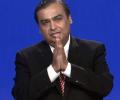
However, in the last few sessions, the stock of Mukesh Ambani-controlled Reliance Industries Limited (RIL), hit its 52-week low level of Rs 2269.75, and has been one of the worst performers among the Sensex pack thus far in calendar year 2023 (CY23). Thus far in CY23, RIL has tanked nearly 11 per cent as compared to a fall of around 5 per cent in the S&P BSE Sensex. The fall in the stock, according to Gaurang Shah, senior vice-president at Geojit Financial Services is mostly due to the overall dip in the market sentiment, which in turn has impacted large-caps, including RIL.

Eight of the top-10 most valued firms together lost Rs 2,21,555.61 crore from their market valuation last week in-line with the weak trend in the broader market, with Infosys and HDFC Bank suffering the biggest hit. The 30-share benchmark index, Sensex, lost 1,141.78 points or 1.95 per cent last week. From the top-10 pack, only Reliance Industries and Adani Green Energy emerged as the gainers.
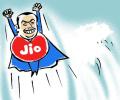
A record over Rs 1.5 lakh crore worth of 5G telecom spectrum was sold in a seven-day auction ending on Monday, which saw billionaire Mukesh Ambani's Jio emerging as the top bidder to consolidate its leadership position. Sources with direct knowledge of the matter said provisional data puts the total bids at Rs 150,173 crore. The mop-up from the 5G spectrum, capable of offering ultra-high speed mobile internet connectivity, is almost double at Rs 77,815 crore worth 4G airwaves sold last year and triple of Rs 50,968.37 crore garnered from a 3G auction in 2010.

The top-10 valued companies added a whopping Rs 2.72 lakh crore to their market valuation last week, as the domestic equity benchmarks witnessed heavy buying tracking an overall bullish trend in global equities. The benchmark indices made strong gains in the holiday-truncated week. The 30-share BSE Sensex climbed 2,313.63 points or 4.16 per cent, while the NSE Nifty advanced 656.60 points or 3.95 per cent. Mirroring the bullish trend in the broader market, the combined market capitalisation (m-cap) of the country's top-10 firms zoomed by Rs 2,72,184.67 crore during last week.

The government should convert Vodafone Idea's (Vi) debt into equity to avoid a duopoly in the telecom sector, Deutsche Bank Research said in its report on Monday. This, the bank suggested, would be the only viable solution in the backdrop of the Supreme Court dismissing the telecom company's application for recomputation of adjusted gross revenue (AGR) dues.

IndusInd Bank was the top gainer in the Sensex pack, soaring over 7 per cent, followed by Bharti Airtel, HCL Tech, Tata Steel, Tech Mahindra and Dr Reddy's.

It emerges that Vi has probably offered good data quality despite being short on spectrum and infrastructure due to its stretched finances. Did the two companies that merged face the heat due to price wars? Probably. Did the government's tough stance in demanding its "due" share of telecom revenues hurt the company? Certainly!

Govt to play enabler not handler, India never had more decisive government: PM Modi Prime Minister Narendra Modi on Monday cited his dispensation's push for wide-ranging reforms, including the privatisation of Air India, to assert that the country never had a more "decisive government". Launching the Indian Space Association (ISpA), an industry body aspiring to be the voice of the country's space sector, Modi noted that fields like mining, coal, defence and space have been opened to private players, and said his government's clear policy about public sector enterprises is to open those to private industry where its presence is not required. While opening a host of sectors, the government has built a regulatory environment in which priority has been given to national interest as well as the interests of different stakeholders, he said.

Benchmark stock indices rebounded around 1 per cent on Thursday following value buying in banking, IT and auto stocks after two days of losses and a largely positive trend in global markets. The 30-share BSE Sensex climbed 659.31 points or 1.12 per cent to settle at 59,688.22. During the day, it jumped 683.05 points or 1.15 per cent to 59,711.96. The broader NSE Nifty rose by 174.35 points or 0.99 per cent to close at 17,798.75.

Confirming the SOX compliance exercise, a senior Bharti group executive, however, denied that the company was considering a foreign listing.

Reliance Industries, the Tata group, Bharti Airtel and Aditya Birla are among Indian conglomerates that have hedged their revenue and costs linked to the US dollar, giving them financial cover as the rupee fell past 80 against the greenback on Tuesday.

IndusInd Bank was the top gainer in the Sensex pack, jumping nearly 5 per cent, followed by Bharti Airtel, HCL Tech, Reliance Industries, Titan and Asian Paints.
Sunil Mittal's plan to merge his Bharti Airtel - India's biggest mobile-phone operator -with South Africa's MTN, coupled with the company's 3G foray, is likely to put pressure on its balance sheet, as the estimated cash requirement would be Rs 40,475 crore (Rs 404.75 billion) in this fiscal.
The member operators are SingTel (Singapore), SingTel Optus (Australia), Maxis (Malaysia), Taiwan Mobile (Taiwan), Telkomsel (Indonesia), Globe Telecom (POhilippines), CSL (Hong Kong) and Airtel (India).\n\n

Equity benchmark Sensex rallied 515 points on Thursday to reclaim the 59,000-level, propelled by heavy buying in IT, banking and financial stocks amid sustained foreign fund inflows. The 30-share BSE index ended 515.31 points or 0.88 per cent higher at 59,332.60. Similarly, the broader NSE Nifty gained 124.25 points or 124.25 per cent to close at 17,659.

Benchmark indices Sensex and Nifty gave up early gains to close in negative territory on Thursday dragged down by IT and pharma stocks which fell amid fears of recession in the global economy. The 30-share Sensex opened higher and rose further to touch a day's high of 60,676.12 on gains in auto and capital goods shares. However, it gave up all early gains and later closed 412.96 points or 0.68 per cent lower at 59,934.01.

Private equity investments into domestic companies fell sharply year-on-year by 42 per cent to $23.3 billion in 2022, which is the lowest since 2019, when it was $15.8 billion, according to an industry report. The numbers reflect the overall funding winter that the startup space in particular, and the overall foreign investments in general have been witnessing since the Ukraine war began last February. Private equity investment inflows into the country fell by a sharp 42 per cent in 2022 from last year to $23.3 billion -- the lowest annual inflows since 2019 when it was a low $15.8 billion, but still relatively elevated compared to historical levels, said Elaine Tan, a senior analyst at Refinitiv, the LSEG business arm that provides financial markets data and insights.

The Telecom Regulatory Authority of India (Trai) has directed the Cellular Operators Association of India (COAI) to make a presentation detailing the pros and cons of the controversial Indian 5G standard, also known as 5Gi, which the government has been pushing for. The move comes after serious differences emerged among telcos with regard to the technology's efficacy and implementation.
Mobile entertainment developer Indiagames Ltd., has announced its partnership with SingTel (Singapore Telecommunications Ltd) to launch Asia Pacific's first and largest competition for mobile gamers - World Cyber Games (mobile).

Tata Steel was the top loser in the Sensex pack, shedding around 4 per cent, followed by Kotak Bank, Bajaj Auto, M&M, Bharti Airtel, Reliance Industries, IndusInd Bank and Maruti. NSE Nifty declined 70.75 points to close at 16,983.20.

Equity benchmark Sensex extended its winning run to the fourth day running on Monday and reclaimed the 58,000-level, tracking firm global trends and fresh foreign fund inflows. Buying in index major Reliance Industries added to the momentum. The 30-share BSE benchmark climbed 545.25 points or 0.95 per cent to settle at 58,115.50. During the day, it jumped 600.42 points or 1 per cent to 58,170.67. The broader NSE Nifty advanced 181.80 points or 1.06 per cent to 17,340.05.

While smart boys like the Ruias of Essar, Ajay Piramal, Max India promoter Analjit Singh laughed all the way to the bank, the Tatas, Anil Ambani, Malaysian tycoon T Ananda Krishna of Maxis (which invested in Aircel), Sistema, and Norway's Telenor burnt their fingers, notes Surajeet Das Gupta.
Bharti Airtel, India's leading private telecom service provider, is keen to acquire a player similar in size to South African giant MTN in the emerging markets to become a global brand, said Akhil Gupta, deputy group CEO and managing director of Bharti Enterprises.
Bharti Airtel, India's leading private telecom service provider, is keen to acquire a player similar in size to South African giant MTN in the emerging markets to become a global brand, said Akhil Gupta, deputy group CEO and managing director of Bharti Enterprises.

Telecom infrastructure player Indus Towers has been largely ignored by investors with occasional bursts of trading when there's news flow. For example, the stock fell from Rs 188 (Jan 1, 2023) to Rs 135 (Jan 27) and then bounced back to Rs 165 in early February as the Government of India (GoI) converted Vodafone Idea's (Vi) debt into equity and Bharti Airtel pushed up its direct stake in Indus to 47.95 per cent. The cash-strapped Vi holds 21 per cent stake in Indus Towers and Indus also has substantial receivables to come in from Vi which is a negative overhang.

Benchmark indices gained for the third day running on Friday, with the Sensex climbing over 300 points amid mixed global market trends. The 30-share BSE benchmark advanced 303.38 points or 0.56 per cent to settle at 54,481.84. During the day, it jumped 448.68 points or 0.82 per cent to 54,627.14. The broader NSE Nifty went higher by 87.70 points or 0.54 per cent to end at 16,220.60.

Benchmark indices bounced back on Wednesday after a two-day decline, with the Sensex and Nifty climbing nearly 1 per cent each, tracking a positive trend in European markets. Buying in IT and bank stocks also supported the recovery in equities. The 30-share BSE benchmark jumped 547.83 points or 0.99 per cent to settle at 55,816.32.

Equity market capitalisation dropped to a seven-month low in February, with the top 10 companies losing a whopping Rs 3,33,307.62 crore in market valuation last week. The total equity market capitalisation (m-cap) in February 2022 stood at Rs 2,49,97,053.39 crore. The previous low was in July 2021, when the m-cap of BSE-listed companies was at Rs 2,35,49,748.9 crore. In January, the m-cap stood at Rs 2,64,41,207.18 crore.
HCL Tech was the top gainer in the Sensex pack, rising over 4 per cent, followed by TCS, Bajaj Finserv, Nestle India, Bharti Airtel, Bajaj Finance and Tech Mahindra. NSE Nifty advanced 45.95 points to 16,496.45.

India's traditional companies are now moving full scale into the renewable and alternative energy space that had been dominated by smaller players over the past decade. Companies such as government-owned NTPC and the Adani and the Tata groups restructured their businesses well in time to become major players in the green space. At the same time, other conventional companies, such as Larsen & Toubro and Reliance Industries Ltd (RIL), which have a presence both in the energy sector as well as myriad other activities - construction, technology and retailing - are tying up with new-age companies to hitch a ride to a greener path.
Bharti Airtel, India's largest cellular operator, is planning to raise its offer to about $22.63 per share to acquire control of South African mobile player MTN, according to a media report. Quoting a person familiar with the 'deal,' the Wall Street Journal said on Monday that Bharti is considering raising the offer to about 175 South African rand (or $22.63) per share for control of MTN.
Even at a slight premium, Bharti should buy into MTN since there are synergies.

Benchmark indices settled lower on Friday, with the Sensex declining 111 points on the back of a sharp fall in index heavyweight Reliance Industries. The BSE benchmark went lower by 111.01 points or 0.21 per cent to settle at 52,907.93. During the day, it tanked 924.69 points or 1.74 per cent to 52,094.25. The NSE Nifty dipped 28.20 points or 0.18 per cent to close at 15,752.05.

Consumers can expect a 5G launch in the country soon. Telecom companies (telcos) say if auctions take place on time - the target is July - they would be able to offer some services in a few cities by the end of this year and a full roll-out from 2023. But the question is: will 5G turn the tables for telcos financially? Will average revenue per user (ARPU) improve? Will mobile consumers upgrade to 5G quickly and pay more? Will the expanded functions that 5G enables drum up sufficient revenues? In simple terms, will telcos make more money?

Based on industry estimates, telecom companies, including Bharti Airtel, Reliance Jio, Vodafone Idea and BSNL, are expected to invest over $10 billion on buying 5G telecom equipment in the next five years as they transition from non-standalone networks to standalone 5G networks.

Bharti Airtel chairman Sunil Mittal on Thursday said tariffs need to go up amid "tremendous stress" in the telecom sector, and Airtel will not hesitate to raise prices, but it will not do so unilaterally. The comments by the telecom czar came at a time when Airtel's rival Vodafone Idea has approached the government for a one-year moratorium on payment of spectrum instalment of over Rs 8,200 crore - due in April 2022. Cash-strapped VIL has told the telecom department that while it is working on raising new funding for the last six months, "investors are not willing to invest in the company because they believe that unless there is a significant improvement in consumer tariffs, the health of the industry will not recover and they will incur a loss on their investment".

At a time when there is a growing number of edtech companies laying off employees in a bid to conserve cash and focus on profitability amid a funding winter, Ronnie Screwvala-led upGrad is expanding its facilities and hiring talent. The company plans to hire over 1400 team members between November 2022 and March 2023 in India and at offices outside the country. upGrad has also signed new leases in the past few months for 335,000 sq ft of space across four cities -- Mumbai, Bengaluru, Pune and Noida.

Equity benchmarks ended modestly higher on Friday after the Reserve Bank raised the key interest rate in an effort to cool stubbornly high inflation and defend the rupee. Continuous foreign fund inflows into the capital markets and softening crude oil prices also helped the bourses regain momentum, traders said. The 30-share BSE Sensex ended 89.13 points or 0.15 per cent higher at 58,387.93 after facing volatility during the fag-end of trade. During the day, it climbed 350.39 points or 0.60 per cent to 58,649.19. The broader NSE Nifty went up by 15.50 points or 0.09 per cent to finish at 17,397.50.
Equity indices staged a pullback on Tuesday after three days of declines as investors scooped up IT, metal and consumption stocks amid a largely positive trend overseas. A recovery in the rupee added to the momentum, traders said. Overcoming a wobbly start, the 30-share BSE Sensex climbed 274.12 points or 0.45 per cent to settle at 61,418.96.

ONGC was the top loser in the Sensex pack, shedding around 4 per cent, followed by NTPC, PowerGrid, M&M, Nestle India, SBI and HCL Tech. On the other hand, HUL, Bajaj Auto, Bharti Airtel, Bajaj Finserv were among the gainers.
 © 2026 Rediff.com - Advertise with us - Disclaimer - Privacy Policy - Sitemap - Feedback - About us - Terms of use - Grievances